
What Happens During a Water Line Replacement: Step by Step
If your water service line needs to be replaced, here is the usual order of work, and the questions worth asking before anyone starts digging.
Referral service: Gardena Water Line Pros is not a plumbing contractor. Your call may be connected to an independent, third-party service provider who sets its own availability, pricing and terms. Read our referral disclosure.
The short answer
A replacement usually follows this order: confirm the line needs replacing, choose a method, sort out permits and utility markings, shut off the water, install the new line, test it, restore the surface, and flush the system. Timing and details vary by site and provider, so this guide gives the sequence, not a schedule.
Step 1: Confirm the problem and locate the line
A provider looks at the symptoms, the age and material of the pipe, and the route of the line from the meter to the house. If the location of a leak is unclear, they may use listening equipment (see leak detection). This is also when repair and replacement get compared: repair vs. replacement.
Step 2: Choose the method
The two broad approaches are open trenching and trenchless replacement. What is above the line (lawn, driveway, walkway, landscaping), its depth and the soil all affect which one fits. Read when trenchless may be an option.
Step 3: Permits and utility markings
- Permits. The City of Gardena's encroachment and excavation page says an encroachment permit from the Engineering Division is required for work in places such as the street, curb, gutter, sidewalk and driveway. Other permits may apply depending on the job. Ask the provider which ones they handle.
- Utility markings. Before anyone digs, underground utilities need to be marked. Calling 811 is how that request is made.
- The utility's part. The meter and meter box belong to Golden State Water, and Rule No. 16 divides responsibility along the line (see the responsibility guide). Confirm with the utility how the new line will connect at the meter before work begins.
Step 4: Water shut-off
Water to the house is typically off while the old line is disconnected and the new one is connected. Ask when it will go off, how long to expect, and what you can use water for in the meantime.
Step 5: Excavation or access
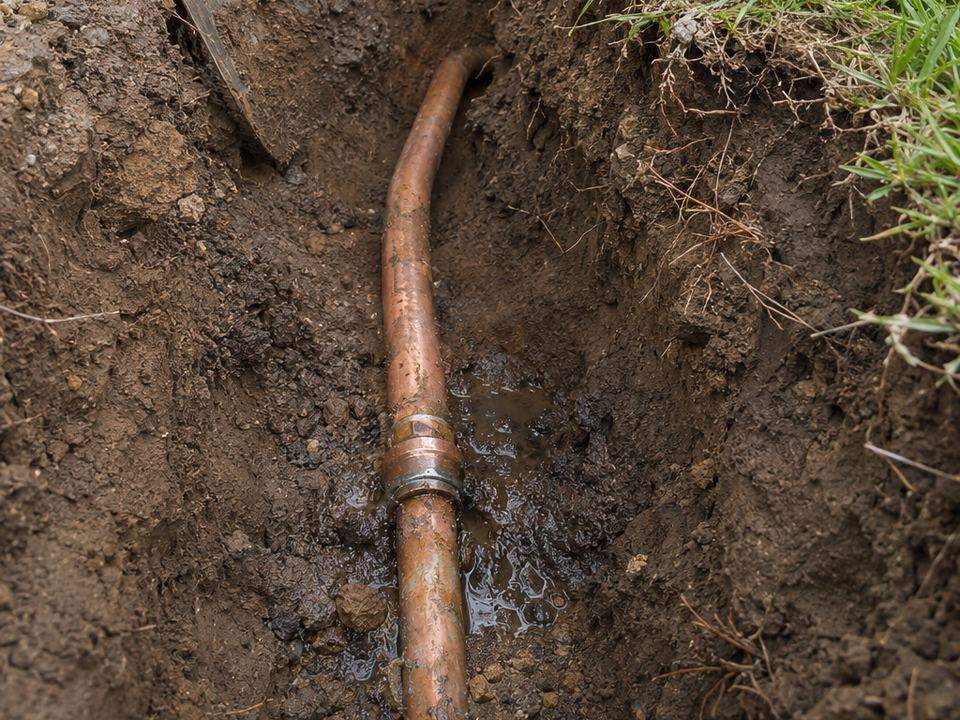
With open trenching, a trench follows the line's path. With trenchless methods, small pits are dug at the ends instead. Either way, expect equipment, soil piles and some restricted access around the work area.
Step 6: Install and connect the new line
The new pipe is installed and connected at the meter end and at the house. The pipe material is a choice you can ask about: see how to check what your pipe is made of for the common materials.
Step 7: Test and inspect
The new line is typically tested for leaks before it is covered. If the work required a permit, an inspection may be part of the process.
Step 8: Backfill and restoration
The trench or pits are filled and compacted, and surfaces are put back. Restoration of concrete, lawn and landscaping is often a separate scope, so get it in writing.
Step 9: Turn the water back on and flush
When service returns, run taps to clear air and any sediment, and check fixtures and the meter for leaks. Our meter check works as a quick after-test.
Questions to ask before you agree to anything
- Which permits are needed, and who pulls them?
- What method will be used, and why does it suit this site?
- What pipe material will be installed?
- Is surface restoration included, and what exactly does it cover?
- When will the water be off, and for how long?
- What does the written scope say about unexpected conditions?
This guide is general information. Requirements depend on the site, the provider and the City of Gardena and Golden State Water, so confirm details with them. Cost factors are covered in what affects water line repair cost. Gardena Water Line Pros is a referral service, not a plumbing contractor.
Read next
Frequently asked questions
Will my water be off during a replacement?
Usually yes, at least for part of the work, because the old line has to be disconnected from the new one. Ask your provider how and when the shut-off will happen and how long they expect it to last.
Do I need a permit to replace a water service line in Gardena?
It depends on the work and where it happens. The City of Gardena says an encroachment permit from the Engineering Division is required for work in places such as the street, curb, gutter, sidewalk and driveway. Ask your provider which permits apply and who pulls them.
Who restores the lawn or concrete afterward?
It depends on the provider and the agreed scope. Some include restoration, others treat it separately. Ask for it to be spelled out before work begins.
Can a line be replaced without a long trench?
Sometimes. Trenchless methods use small access points instead of one continuous trench, but they are not suitable for every site. See our trenchless guide for the conditions that matter.
Think your water line may need replacing?
Call to be connected with an independent provider, when one is available, to assess the line and explain the options.
Referral service: Gardena Water Line Pros is not a plumbing contractor. Your call may be connected to an independent, third-party service provider who sets its own availability, pricing and terms. Read our referral disclosure.