
Pressure Reducing Valve (PRV) Problems: Signs and What to Check
A pressure reducing valve keeps incoming water pressure in a safe range. When pressure swings, it is one of the first things worth checking.
Referral service: Gardena Water Line Pros is not a plumbing contractor. Your call may be connected to an independent, third-party service provider who sets its own availability, pricing and terms. Read our referral disclosure.
The short answer
A pressure reducing valve (PRV), also called a pressure regulator, lowers and steadies the water pressure that enters your home. EPA WaterSense says fixtures operate best between 45 and 60 psi and that a PRV may be installed to hold pressure in that range. The quickest way to know whether pressure is a problem is to measure it with a gauge.
Where the PRV is
If your home has one, it is usually a bell-shaped brass valve on the incoming line near the main shut-off valve, often close to where the pipe enters the house. Not every home has one. If you can't find it, a plumbing provider can tell you whether your home has a regulator and where it sits.
How to test your pressure
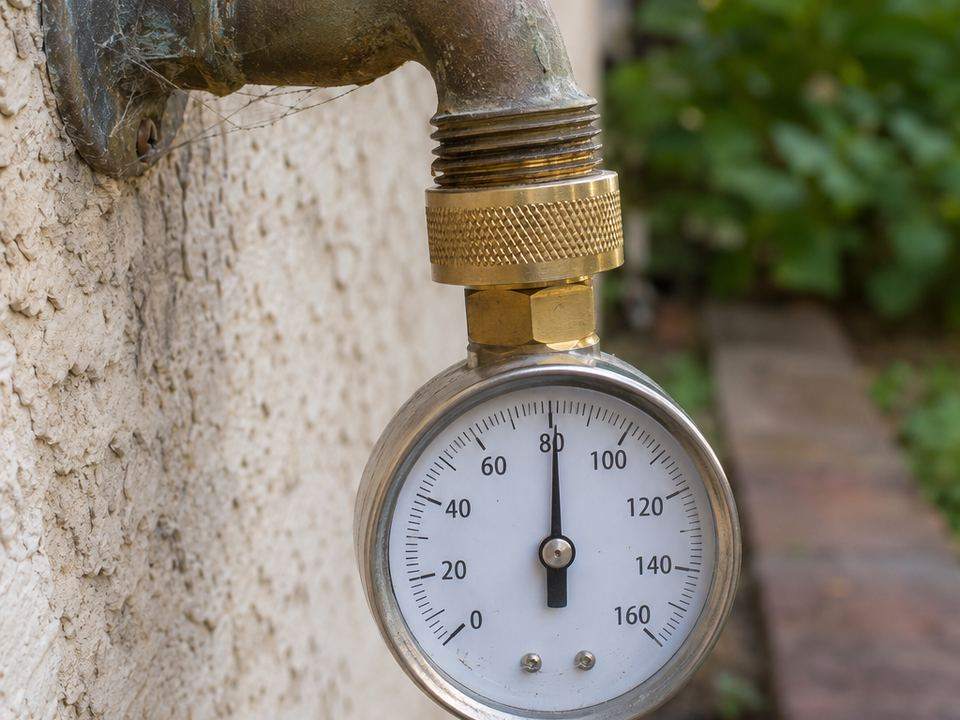
EPA WaterSense describes a simple home test using a water pressure gauge from a hardware store:
- Turn off all water-using fixtures and appliances, indoors and outdoors.
- Screw the gauge onto an outdoor hose bib.
- Turn the water on to the fully open position and read the gauge.
EPA says that if pressure is much too low, you may need to find and fix a leak in your home, and if it is much too high, you may want a professional to adjust or install a PRV to maintain pressure at 60 psi.
Possible signs of a PRV problem
| What you notice | Could point to | Check first |
|---|---|---|
| Pressure much higher than before, at every fixture | Regulator stuck open or set too high | Gauge test at a hose bib |
| Pressure that rises and falls on its own | Regulator wearing out, or changes on the utility side | Test at different times of day |
| Banging pipes when a tap shuts off | High pressure or sudden flow changes | Gauge test |
| Whole-house low pressure | Regulator problem, partly closed main valve, restricted pipes, or a leak | Main valve, then meter, then ground |
| Faucets or toilets that drip or run more often | Sustained high pressure stressing fixtures | Gauge test |
A symptom isn't a diagnosis. These signs have several possible causes. A gauge reading and an on-site look are the only reliable way to tell a regulator problem from a service line or utility-side problem.
Rule out the water line
If pressure is low rather than high, look beyond the valve. A moving meter with everything off, wet ground between the meter and the house, or a sudden pressure drop can point to a leak in the service line. Our guides on low pressure in the whole house and the meter leak check walk through the steps. Old galvanized pipe can also restrict flow over time: see galvanized and polybutylene lines.
What a provider usually does
A provider typically measures static pressure, checks the regulator and main valve, and looks for signs of a leak. A regulator can often be adjusted or replaced without touching the buried line. If the problem turns out to be the buried line, the options are covered in repair vs. replacement.
Pressure figures come from EPA WaterSense. This guide is general information, not a diagnosis. Gardena Water Line Pros is a referral service, not a plumbing contractor.
Read next
Frequently asked questions
What water pressure is normal for a house?
EPA WaterSense says fixtures work best when a home's incoming water pressure is between 45 and 60 pounds per square inch (psi), and that a pressure-regulating valve may be installed to maintain that range.
How do I test my water pressure?
Turn off all water-using fixtures, attach a pressure test gauge from a hardware store to an outdoor hose bib, and turn the water on fully. EPA WaterSense describes this test on its home maintenance page.
Can a bad pressure regulator cause low pressure?
It can, but low pressure has other common causes too, such as a partly closed main valve, restricted older pipes or a leak. Check those before assuming the regulator is the problem.
Who should adjust or replace a pressure reducing valve?
EPA WaterSense says that if pressure is much too high, you may want a professional to adjust or install a pressure-regulating valve to help maintain 60 psi.
Pressure problem that isn't the valve?
Call to be connected with an independent provider, when one is available, to look at your water service line.
Referral service: Gardena Water Line Pros is not a plumbing contractor. Your call may be connected to an independent, third-party service provider who sets its own availability, pricing and terms. Read our referral disclosure.